
Category: IBM Planning Analytics | Read time: 7 min | Author: Rick Stevenson, CPA/CMGA
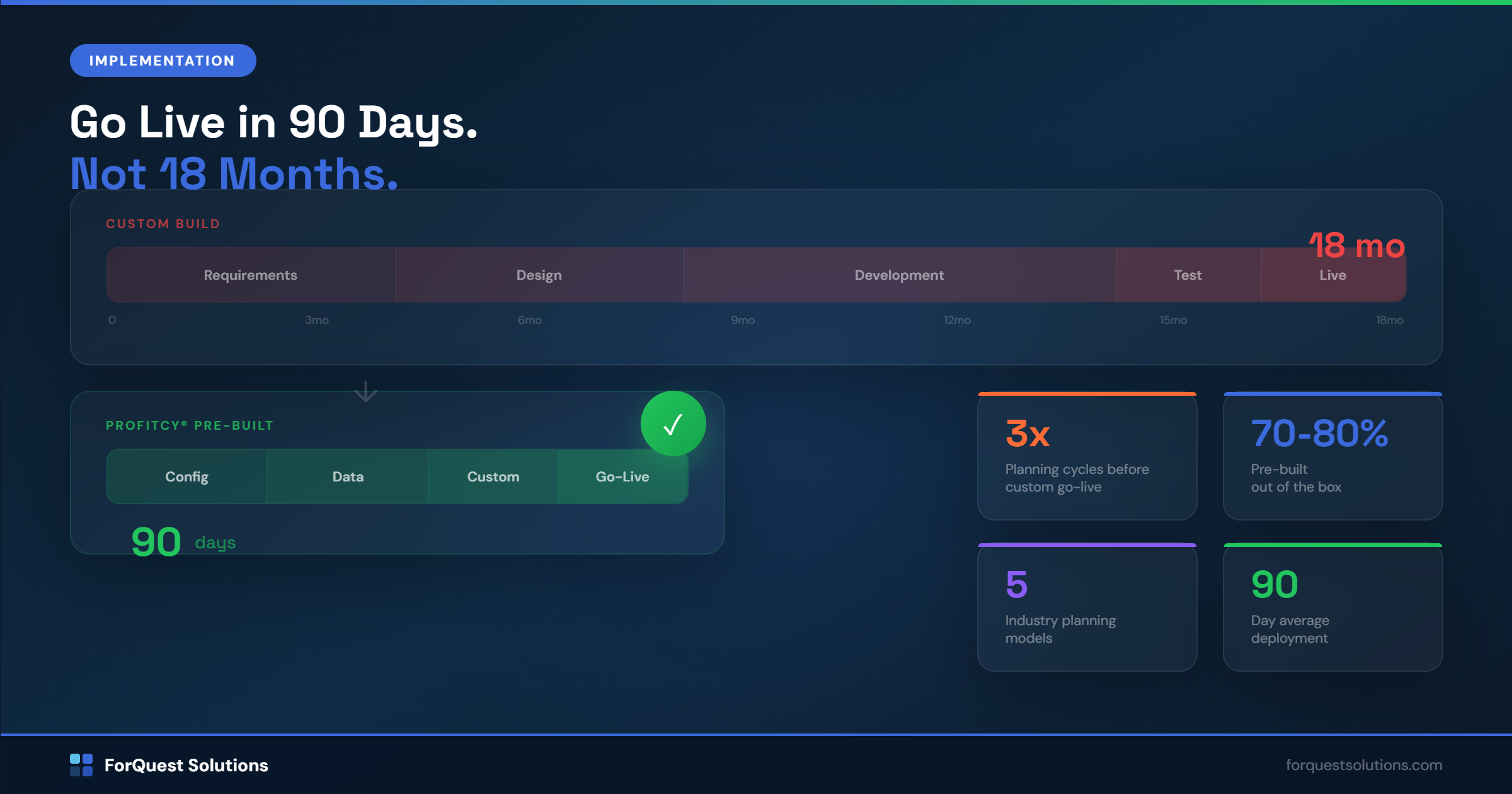
Here’s a scenario that plays out every year at hundreds of companies: the CFO approves an IBM Planning Analytics implementation. A consulting firm scopes the project at 12–18 months. Budget: $500K–$1.5M. Twelve months later, the team is still in development, the budget is blown, and the finance team is still running their planning process in spreadsheets.
It doesn’t have to be this way.
The Custom Build Trap
Traditional TM1 implementations start from scratch. A team of consultants interviews stakeholders, documents requirements, designs a data model, builds cubes and dimensions, writes rules and feeders, creates Turbo Integrator processes, and designs PAW dashboards — all custom, all from a blank canvas.
This approach made sense 15 years ago when every company’s planning process was genuinely unique. But after 25 years of building TM1 models across Banking, Manufacturing, CPG, Retail, and Financial Services, a pattern emerges: 70–80% of every model is the same.
Every financial planning model needs a chart of accounts dimension. Every model needs time, version, entity, and currency handling. Every model needs a P&L cube, a balance sheet cube, and a cash flow cube. Every model needs data integration from the general ledger. Every model needs variance analysis, rolling forecasts, and executive dashboards.
The custom build approach means you’re paying consultants to re-engineer these common components from scratch — every single time.
The Pre-Built Model Approach
Pre-built models flip the equation. Instead of starting from zero, you start from a production-ready framework that already includes the cubes, dimensions, rules, feeders, TI processes, and dashboards that every planning model needs.
At ForQuest Solutions, we built ProfitCy® specifically for this purpose. ProfitCy is a set of pre-built planning models on IBM Planning Analytics, designed by consultants who’ve spent over two decades building TM1 environments for enterprise finance teams.
What “pre-built” actually means:
It’s not a template or a demo. ProfitCy is production-grade software: fully functional cubes with business rules and feeders already written, TI processes for data integration already built, PAW dashboards already designed, and workflow already configured. What you configure is the metadata that makes it yours — your chart of accounts, your organizational hierarchy, your cost centers, your planning calendar.
What’s Included Out of the Box
ProfitCy covers five planning modules, each available independently or as an integrated suite:
Financial Planning & Reporting — P&L, balance sheet, cash flow, driver-based revenue and expense planning, rolling forecasts, variance analysis, and board-ready reporting. Supports top-down targets with bottom-up input from cost center managers.
S&OP & Demand Planning — Statistical baseline forecasting, commercial overrides, supply planning with capacity constraints, inventory optimization, and a structured S&OP consensus workflow from pre-meeting through executive sign-off.
Workforce Planning — Position-level headcount budgeting, compensation modeling (salary, benefits, bonus, equity), new hire planning with start-date proration, attrition modeling, and FTE-to-cost bridging connected to the financial model.
Sales Planning — Territory design and alignment, quota setting with top-down/bottom-up reconciliation, pipeline analytics, revenue forecasting (commit/upside/best-case), and compensation modeling for commissions and accelerators.
Operations Planning — Production planning, CapEx budgeting with depreciation schedules, cost center management, activity-based allocation, and operational KPI dashboards.
Each module comes with industry-specific configurations for Banking, Manufacturing, CPG, Retail, and Franchising — because a bank’s financial planning model has fundamentally different requirements than a manufacturer’s.
90 Days: What the Timeline Actually Looks Like
A typical ProfitCy deployment follows a structured 90-day path:
Weeks 1–2: Discovery & Configuration
We map your chart of accounts, entity structure, and planning calendar to the ProfitCy data model. Your GL feed is connected via TI processes. This is configuration, not development — the cubes, rules, and dashboards already exist.
Weeks 3–5: Data Integration & Validation
Historical data flows in from your ERP. We validate balances, test rules, and confirm that calculated measures (margins, variances, allocations) tie to your source of truth. Your finance team reviews the numbers.
Weeks 6–8: Customization & Workflow
This is where the 20–30% of custom work happens — your unique allocation methodology, your specific board reporting format, your approval workflow. We build what’s unique to you on top of the framework that’s already production-ready.
Weeks 9–10: UAT & Training
Your team tests the full planning cycle: budget entry, forecast refresh, consolidation, reporting. We train end users, power users, and administrators.
Weeks 11–12: Go-Live & Hypercare
Production launch with dedicated support. We monitor performance, address any post-launch items, and ensure your first planning cycle runs smoothly.
Compare this to a custom build where weeks 1–8 are still in the design phase.
The Math: Pre-Built vs. Custom
Here’s a realistic comparison for a mid-market company implementing financial planning and workforce planning on IBM Planning Analytics:
Custom Build
Timeline: 12–18 months. Consulting hours: 2,000–4,000 hours. Cost: $600K–$1.2M. Risk: High — every component is net-new code. Time to first planning cycle: 12+ months.
ProfitCy Pre-Built
Timeline: 90 days. Consulting hours: 400–600 hours. Cost: Significantly less than custom. Risk: Low — proven framework with 20+ deployments. Time to first planning cycle: 90 days.
The cost savings are significant, but the real value is time. A company that goes live in 90 days gets three planning cycles of value in the time it takes a custom build to reach go-live.
“But Our Requirements Are Unique”
This is the most common objection — and it’s usually wrong.
After 25 years and dozens of implementations, we’ve found that most companies overestimate how unique their planning requirements are. Yes, your allocation methodology is specific to you. Yes, your board package has a particular format. Yes, your organizational hierarchy is yours alone.
But the planning engine underneath — the P&L structure, the consolidation logic, the version management, the currency handling, the workflow, the security model — is the same across industries. That’s the 70–80% that ProfitCy delivers on day one.
The remaining 20–30% is where we customize. And because we’re customizing on top of a proven framework rather than building from scratch, that customization happens in weeks, not months.
Who ProfitCy Is Built For
ProfitCy is designed for companies that are serious about IBM Planning Analytics and want to get to value fast:
- Mid-market companies ($100M–$2B revenue) implementing PA for the first time
- Enterprise teams replacing aging TM1 models that need a modern rebuild
- Companies migrating to PA Cloud from on-premises TM1 who want to modernize their models at the same time
- Organizations that tried a custom build and need to course-correct
ProfitCy is not a starter kit for teams that want to learn TM1. It’s a production-grade planning platform built by people who’ve spent their careers in TM1.
What Our Clients Say
A regional bank deployed ProfitCy Financial Planning and reduced their month-end close from 15 business days to 4 — a 73% improvement. A CPG manufacturer deployed ProfitCy S&OP and cut excess inventory by $2.8M while improving service levels from 91% to 97%. A QSR franchise group scaled from 45 to 120 locations with the same 3-person finance team.
These aren’t 18-month projects. These are 90-day deployments that delivered results in the first planning cycle.
See It for Yourself
If you’re evaluating IBM Planning Analytics — or if you’re stuck in a custom build that’s gone sideways — we’d welcome the opportunity to show you what a pre-built approach looks like.
We offer a free, no-pressure consultation where we walk through ProfitCy, discuss your specific planning requirements, and give you an honest assessment of whether the pre-built approach is right for your organization.
Schedule a Free Consultation →
Rick Stevenson is the Managing Director and founder of ForQuest Solutions, an IBM Planning Analytics consulting firm with 25+ years of TM1 expertise. ProfitCy® is ForQuest’s suite of pre-built planning models for Financial Planning, S&OP, Workforce, Sales, and Operations on IBM Planning Analytics.