
A client called me last year convinced their TM1 model was broken.
It wasn’t broken. It was abandoned.
Twenty minutes into looking at the environment I could see exactly what had happened. Go-live was probably fine. Maybe even smooth. But somewhere in the 18 months since, the model had quietly stopped reflecting the business it was built for — and nobody had noticed until the pain got bad enough to call someone.
I’ve seen this enough times now that I can spot the signs before I even open a cube. Here’s what they look like.
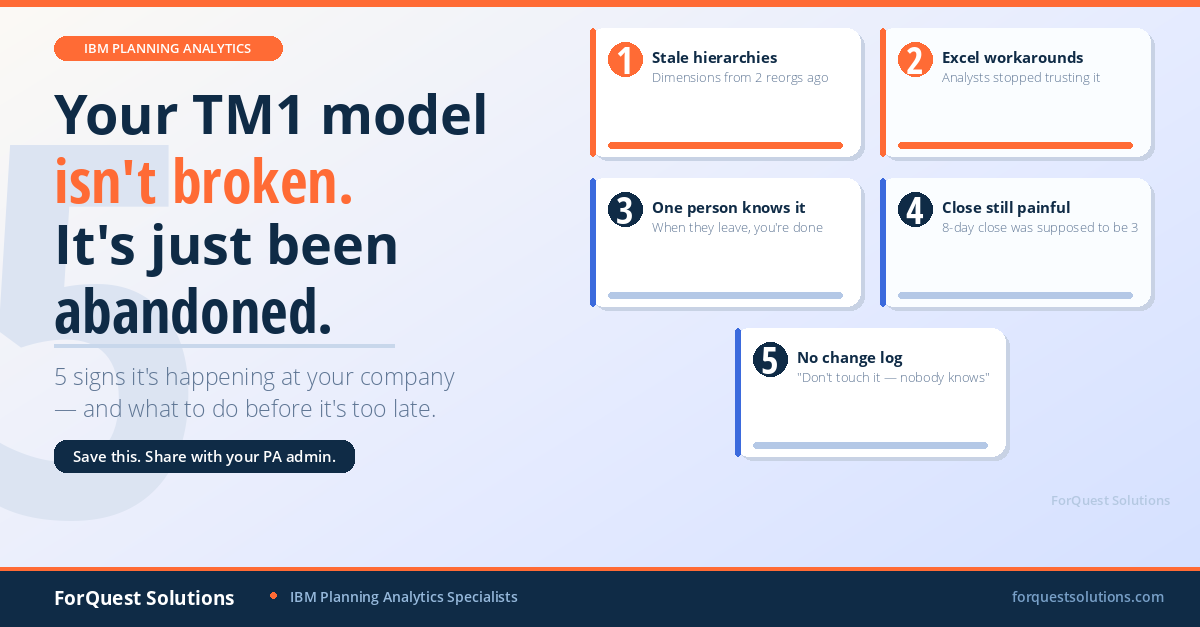
The dimensions still reference the old org
Every business changes. Divisions get restructured, cost centers get retired, product lines get killed or renamed. The TM1 model, if nobody’s maintaining it, still reflects the org as it existed at go-live.
This matters because your allocations, consolidations, and roll-ups are all running on a structure that no longer matches reality. The numbers look plausible. They’re not right. And in my experience, the longer this goes unchecked, the harder it is to unwind — because people have started making decisions based on the wrong structure without knowing it.
The analysts have their own Excel files
This one is the most telling sign of a model in trouble, and it’s almost always present by the time someone calls me.
At some point, the model stopped being able to answer the questions the business was asking. Maybe a new reporting requirement came in and nobody updated the model to handle it. Maybe a data feed broke and instead of fixing it properly someone built a manual workaround. Either way, the analysts adapted — they always do — and those workarounds quietly became the process.
I’ve seen environments where the TM1 model is technically running fine and literally nobody is using it for anything important. All the real work is happening in a shared Excel file that five people are editing via email.
One person holds all the knowledge
There’s always one. The person who built it, who understands why that feeder exists, who can troubleshoot the rules from memory. They’re invaluable and they’re a single point of failure.
I’m not saying this to be grim — it’s just the reality of how these implementations tend to go. The knowledge concentrates in one or two people during the build, and if there’s no deliberate effort to document and spread it, it stays concentrated. Until it walks out the door.
When that happens, the environment effectively becomes a black box. You can run it. You just can’t change it, fix it, or explain it.
Close still takes too long
If your month-end close was supposed to get faster after go-live and it hasn’t — or it got faster initially and then crept back up — something structural is wrong.
Usually it’s one of three things: a data integration problem upstream of TM1 that’s forcing manual intervention, rule performance issues inside the model that are slowing cube calculations, or a process problem that the technology was never properly configured to solve. Sometimes it’s all three.
The tell is when the team has just… accepted it. “Yeah, close takes us 8 days” said with a shrug. That shrug is the sign. It used to bother someone. It stopped bothering anyone. That’s when you know it’s been broken long enough to feel normal.
Nobody knows what changed
In a well-run TM1 environment, changes are controlled. Rule edits are documented. TI process modifications go through some kind of review. When something breaks, you can trace it.
In a drifting environment, changes happen informally. Someone edits a rule in production because it’s faster. Nobody logs it. Three months later something downstream starts behaving strangely and nobody can figure out why because there’s no record of what changed.
The phrase I hear most often in these situations: “Don’t touch that — nobody knows what it does.”
What to do if you recognized your environment
One of these is a yellow flag. Three or more and it’s time to have an honest conversation about the state of your investment.
All of them are fixable. I’ve worked through every one of these patterns across enough environments that the playbook is pretty well established at this point. It usually starts with a proper audit — understanding what the model actually does versus what people think it does — and goes from there.
If any of this sounded familiar, [schedule a free 30-minute TM1 Health Check] and we’ll take an honest look at where things stand.